Orbit Housing Test & Learn (Summer 2026)
Working in Place
In November 2023, Sport England announced investment through its Uniting the Movement strategy to strengthen place-based approaches, recognising that tackling inactivity and inequalities requires hyperlocal solutions shaped with, rather than for, communities. This approach places local people, relationships and lived experience at the heart of understanding what needs to change.
Building on this learning, a Test & Learn was developed with Orbit Housing to explore the experiences of older residents, including people living with frailty, long-term health conditions and restricted mobility. Delivered across four Orbit Housing schemes in Thanet, the work used storytelling to understand how confidence, independence and belonging shape residents’ experiences of physical activity and social participation in their everyday lives.
Orbit Housing
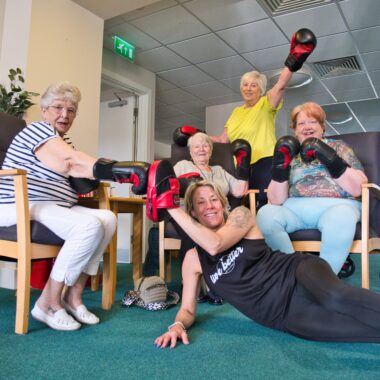
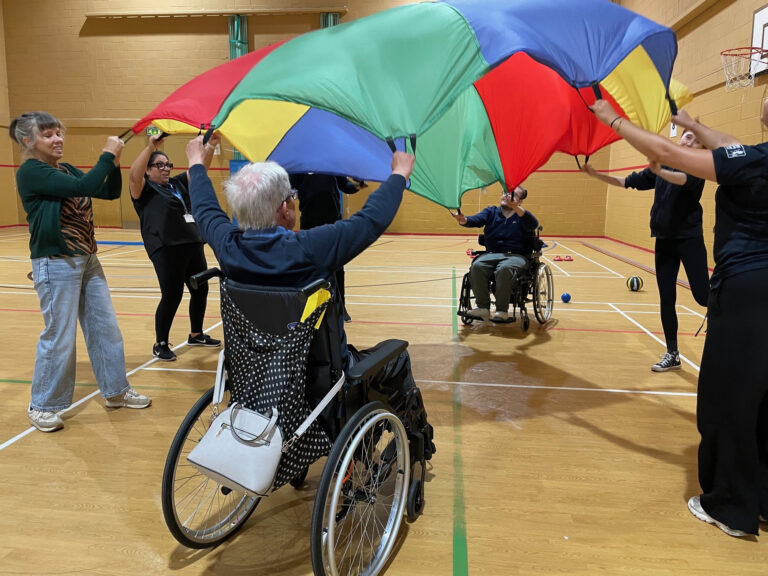
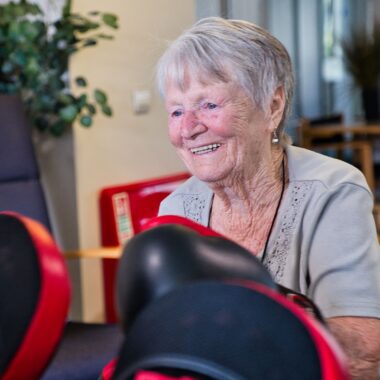
The Orbit Housing project explored how confidence, independence and belonging were experienced by residents across four Orbit Housing schemes in Thanet: Victoria Villas in Margate, Napleton Court in Ramsgate, Cherry Court in Broadstairs and Craven Court in Garlinge. The twelve-week programme was delivered across Victoria Villas in Margate, Napleton Court in Ramsgate, Cherry Court in Broadstairs and Craven Court in Garlinge. It began with activities within each scheme before introducing mixed-scheme participation and supported visits to community settings. Residents could try chair-based exercise, Pilates, yoga, tai chi, boxing, circus skills, judo and indoor games, alongside informal social opportunities.
A qualitative narrative inquiry approach captured how residents experienced confidence, independence and belonging. Evidence came from Community Connector diaries, observations, informal conversations, resident interviews and facilitator interviews. This allowed the evaluation to understand not only whether people attended, but what enabled participation, why residents adapted or withdrew, and how experiences changed over time.
Impact
The programme created meaningful opportunities for residents to become active, connect with others and test assumptions about what they could do.
| BELONGING
Conversation, humour, encouragement and refreshments helped residents learn more about one another and supported a sense of belonging. |
CONFIDENCE
Residents confidence often grew through trying, repeating and succeeding, supported by peers, trusted facilitators and activities that could be adapted. |
| INDEPENDENCE
Independence was not the same as doing everything alone. Practical help, accessible places, trusted people and genuine choice expanded residents’ agency. |
TRUST AND CONSISTENCY
Reliable people and repeated contact made participation feel safer. Relationship-building, reassurance and adaptation were core parts of delivery, not optional extras. |
“She comes just to watch sometimes because of her knees and spine, but she likes being there. That’s her way of taking part.” Community Connector (Cherry Court)
Reflections
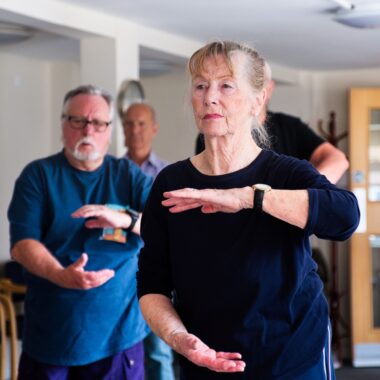
Belonging can enable or restrict participation
Familiarity, shared identity and everyday care helped residents feel secure enough to participate. However, established groups could also create less visible barriers for residents outside them. Opening sessions to people from outside a scheme sometimes widened connection but could also leave residents feeling displaced within communal areas they understood as part of their home.
“You’ve got to trust the people that come in. And we don’t even know the people that come in here, so we can’t trust them.” Resident
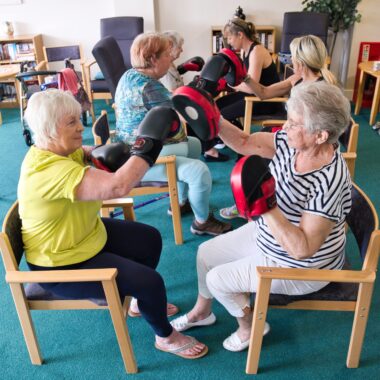
Confidence develops through supported participation
Confidence was more often an outcome of participation than a prerequisite. Low-risk first attempts, repetition, peer encouragement, discreet adaptation and non-judgemental facilitation helped residents reconsider what was possible. Confidence developed in one setting did not automatically transfer to unfamiliar venues, where new physical, social and travel risks emerged.
“In the first session she kept saying ‘I can’t do that’ to nearly every move, but now, three sessions in, she’s attempting everything, even if it’s the adapted version.” Community Connector (Craven Court)
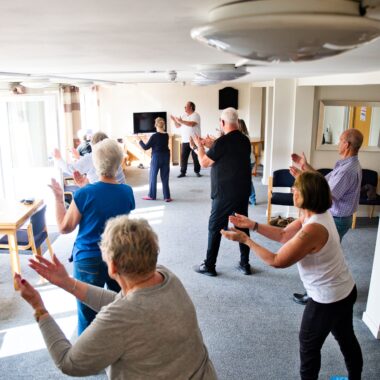
Place and transport change what is possible
Confidence developed in a familiar scheme did not automatically transfer to an unfamiliar venue. Transport needed to be considered as a complete journey, including reaching pick-up points, travelling with mobility equipment, accessing the destination and having trusted companionship.
“It all depends on where it is and if people have got transport or not… Yes, I can get to other places on the mobility scooter. But again… you’ve got to think about people walking from here to bus stops, and then if they can walk it or not.” Resident
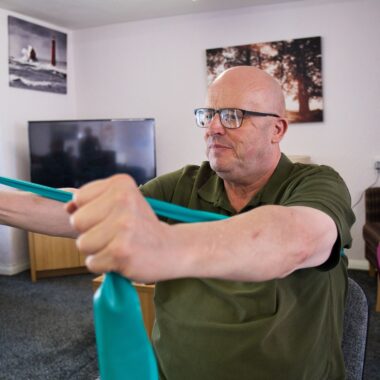
Trust and consistency are core to delivery
Relationships were not an additional benefit; they were part of the programme. Community Connectors, facilitators and scheme managers invited, reassured, adapted, accompanied and followed up with residents. Consistency made sessions predictable and credible.
“People don’t always trust the programme, but they do trust individuals. They’ll come because it’s you, or because it’s Lucas, or because it’s Sarah.” Community Connector
Short-term delivery creates a transition challenge
Some activity blocks ended as familiarity, trust and confidence were beginning to consolidate. Ending well therefore matters. Residents need clear communication and supported routes into continuing opportunities, rather than signposting alone.
“It’s just basically, is it all going to stop and that’s it? … Because we’ve all got used to it and used to it being good.” Resident
Applying the Learning
Future delivery should focus both on what is offered and on the conditions that make participation possible.
- Co-design with residents
Involve residents before decisions are made about the activity, timing, language, location and access. Include people who do not usually use communal spaces, not only established groups.
- Respect the scheme as a home
Discuss external participation with residents. Manage numbers, access and group dynamics so host residents retain safety, ownership and access.
- Invest in consistent relationships
Use facilitators who can build rapport, communicate accessibly and adapt sensitively. Recognise the time Community Connectors and scheme managers spend inviting, reassuring and following up.
- Offer different ways to take part
Treat observing, adapting, resting, leaving early or joining the social element as valid participation. Progress should reflect the person, not a single pathway.
- Plan access and transport from the start
Consider the complete journey, mobility equipment, destination accessibility, information, reassurance and trusted accompaniment before arranging external opportunities.
- Build continuity into short-term work
Explain how long provision will run and what happens next. Where activity ends or transfers, provide a supported transition and assess changes in trust, choice, relationships and capability as well as attendance.
Overall, the Orbit Housing Test & Learn showed that helping people to be more active is about more than providing activities. It relies on trusted relationships, the right support and opportunities that work for people and the places they live. Activity provision alone is insufficient. Sustainable participation depends on trusted people, adaptable opportunities, accessible places, meaningful choice and enough continuity for new experiences to become familiar, credible and repeatable.
Full Report
Follow this link to read the full Orbit Housing Report (Download PDF)
If you require the report in an alternative format, please email activekent@kent.gov.uk
If you’d like to discuss the findings of the report, please contact Alexia Tam, our Insight, Evaluation and Learning Manager (Place) on 03000 415879 or email: alexia.tam@kent.gov.uk